
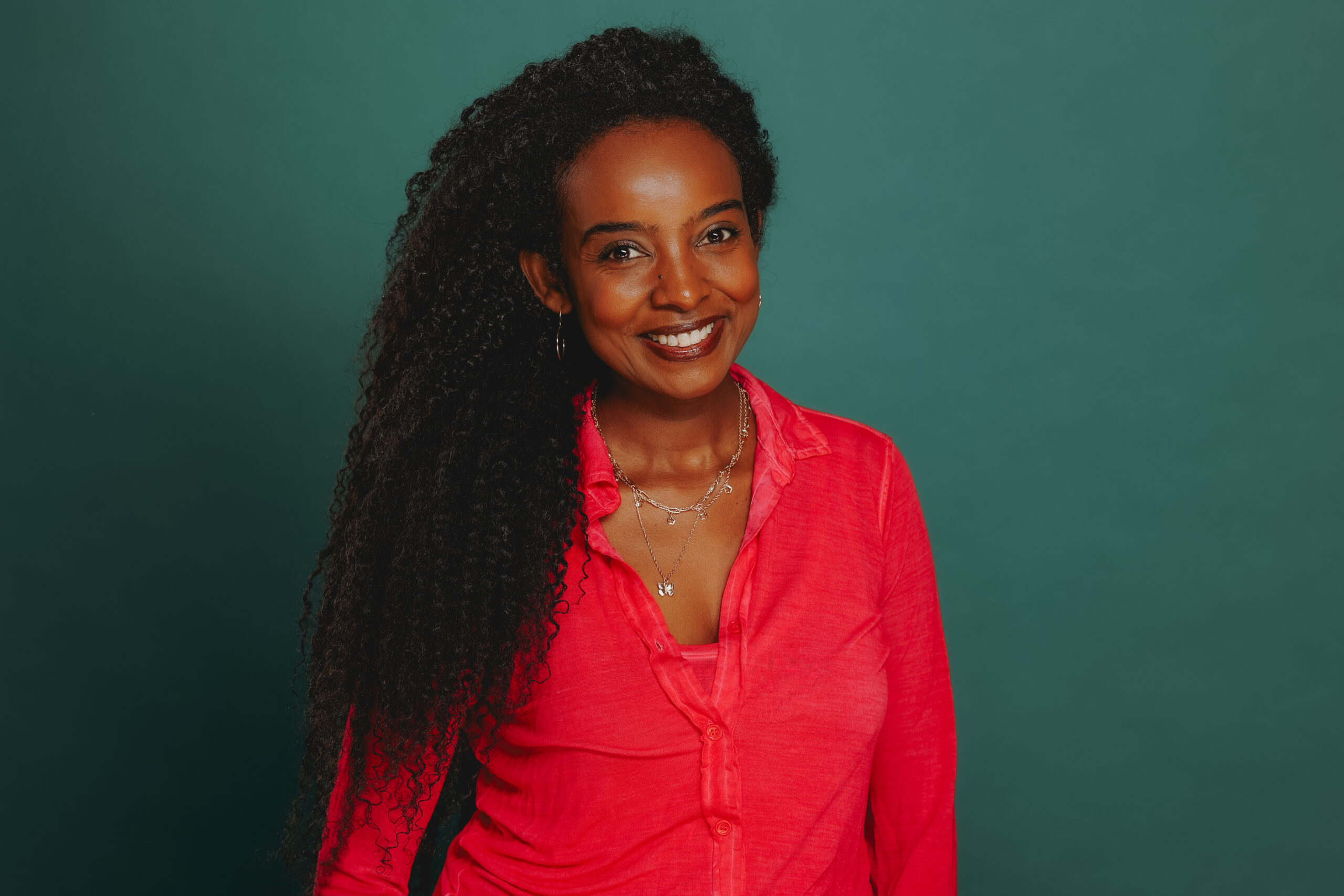
Where Heritage Lives: Salwa Petersen on Home, Ritual, and the Power of Lineage
For some women, home is a place. For others, it is something carried quietly within them through memory, ritual, and the stories passed from one generation to the next.
For Salwa Petersen, home begins in northern Chad, in the quiet rhythms of the Sahel and in the circle of women who gathered to share knowledge, care, and ancestral ritual. Those early experiences, watching her great-grandmother lead the sacred Chébé hair ritual, became the foundation for a life that would eventually span continents, cultures, and industries.
Educated at La Sorbonne, Harvard, and HEC Paris, and with years of experience at L’Oréal, Salwa built the global haircare brand Chéribé from something far deeper than a business idea. At its heart is an heirloom tradition preserved within her family for generations and rooted in the belief that beauty rituals are expressions of dignity, patience, and identity.
Today, Salwa’s work bridges past and present honoring the women of Chad who preserved the Chébé ritual while creating economic opportunity, sustainable development, and a new model for ethical luxury in the beauty industry.
In this conversation, Salwa reflects on lineage, movement, and what it truly means to come home – to our values, our heritage, and ourselves.
Hope+Wellth
You’ve lived many chapters in your life already, from growing up in northern Chad, to studying at Harvard and the Sorbonne, to building a beauty brand rooted in ancestral ritual. When you look back, how do you connect the little girl you were with the woman you are today?
Salwa Petersen
The little girl I was never left. She was observant, grounded, and deeply connected to the women around her: watching their rituals, listening to their stories, absorbing the silence of the Sahel at dawn. Everything I am now is an extension of her, just with more tools. La Sorbonne gave me intellectual rigor, Harvard gave me frameworks, L’Oréal gave me industry mastery, HEC Paris gave me entrepreneurial discipline, but the conviction that what my family carried was extraordinary was always there.
I never had to search for my identity. My family gave me that early: a deep pride in where I come from and an unwavering sense of self. I can recite my lineage back to the 12th century. That grounding is the most valuable inheritance I have ever received, and I make sure to pass it on to my daughter.
H+W
The ritual of Chébé was practiced within your family long before it became widely known. What did those moments look like, and what did they represent beyond hair care?
Salwa
It was never “hair care” in the modern sense. It was a gathering – a circle of women, led by my great-grandmother Chéréye, where knowledge was transmitted through hands, stories, and presence. It was intimacy, trust, and a form of beauty that was spiritual rather than aesthetic. One woman tending to another and saying, without words: I see you. You matter.
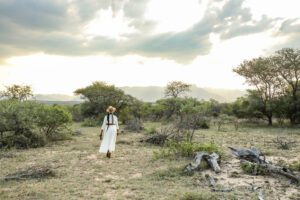 Nothing was taught as instruction. It was absorbed. You learned by watching, by being corrected gently, by listening to the stories woven into the ritual.
Two things shaped me profoundly. First, the belief that caring for your hair is caring for yourself. Not vanity, but dignity and self-respect. Second, patience. Chébé cannot be rushed. That philosophy guided how I built Chéribé: no shortcuts, no compromises, long-term thinking. I spent eight years in research and development before we launched.
In my community, a woman’s hair tells a story of health, discipline, lineage, and the love invested in her. And in a world that has often diminished Black women’s features and natural hair, the Chadian tradition stands as a quiet, powerful counter-narrative. We have always known our deep skin tone is beautiful and our hair is magnificent.
H+W
Chéribé is rooted in care, intention, and impact. What was the original spark that led you to create the brand?
Salwa
My great-grandmother entrusted me with the last heirloom Chébé seeds – the original lineage, long extinct everywhere else. Receiving them came with an unspoken responsibility: do something worthy of this.
When I entered the beauty industry at L’Oréal, I realized two things. Millions of women were struggling with breakage, slow growth, and length-retention challenges; and the solution already existed in what I had been given. At the same time, Chébé was entering the Western market in diluted, inauthentic forms, with no connection to the original seeds or the women who preserved the ritual.
I knew that if I did not act, the ingredient’s legacy would be defined by imitations. I had the authentic source, the heritage, and the training to build it correctly. Chéribé was not a business idea – it was an obligation to my lineage.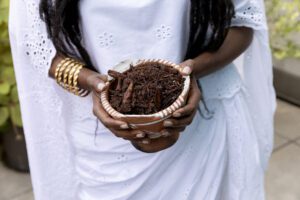
That journey led to the Chébé Complex™: a 100 % natural proprietary extract born from those heirloom seeds and reimagined through modern science in our Parisian lab. It took years and dozens of reformulations to honor the ritual while delivering the performance women deserve. Every drop is still single-source from our farm in Chad. The technology is new. The soul is ancient.
I also knew from the start that I wanted to democratize luxury salon-quality haircare – to make it accessible to every woman, regardless of her budget. Excellence should not be a privilege. That conviction guides every decision we make.
H+W
You’ve created meaningful economic opportunities for women in Chad and supported sustainable development across the Sahel. Why was it important to you that Chéribé’s impact extend beyond the product itself?
Salwa
 Because the product is the impact. The seeds come from our family’s land, stewarded for millennia. The women who harvest and process them are part of the same community that preserved this knowledge. To extract value without returning it would betray everything the ritual stands for.
Vertical integration – from farm to shelf – is not a strategy for us. It is an ethical imperative. Every bottle sold sustains livelihoods, preserves biodiversity, and keeps ancestral knowledge alive. We employ Chadian women in our workshop and pay up to five times the local minimum salary. We support conservation through African Parks. These are not add-ons. They are the architecture of the brand.
H+W
What does “home” look like for the women you work with in Chad, and how does economic stability and dignity play a role in creating a sense of home?
Salwa
In the Sahel, stability is fragile. Climate, conflict, and displacement are constant pressures. For many women, home is something they build and protect daily. When a woman earns her own income, she gains agency – over her children’s education, their food, their future and her own. Economic dignity does not just improve life; it anchors it. It turns a place into a home.
Chadian women are resilient, rooted, and quietly powerful. They hold families together. They preserve traditions. When Chéribé creates economic opportunity, it does not change who they are – it simply gives them the stability to fully be who they already are.
H+W
You’ve described yourself as a modern-day nomad. How has movement and travel influenced your idea of home?
Salwa
I have lived across all five continents and in a dozen countries. I have traveled to over a hundred, and I speak six languages fluently. But the truth is, being a nomad is not something I chose – it is something I inherited. I am Dazagarè and come from the Gorane, nomadic people of the Sahel and original inhabitants of Central Sahara. Movement is in my blood. I simply took it to a global scale.
Home, for me, has never been a single place – it is a feeling. The smell of incense. Daily prayers. My daughter’s laughter. My relationship to God. A meal shared with loved ones. 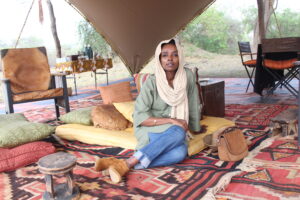 A moment of stillness after a long day.
Movement taught me that home is portable. You carry it in your heart, your rituals, your language, your people. I recreate it wherever I go.
H+W
How do you intentionally create calm or comfort in your home when life feels demanding?
Salwa
Scent, silence, and order. I burn Chadian incense blended by my mother – it transports me instantly. I need my space to be clean, minimal, and fragrant. When my environment is calm, my mind follows.
I also protect my mornings. Every day, I wake at the blue hour, when everything is still and anything feels possible. Before emails, calls, or the rhythm of family life, I need a few moments that belong only to me. That is where I reset.
 H+W
H+W
How does your home reflect who you are in this season of your life?
Salwa
It reflects someone in motion, but deeply rooted. My husband’s German and Danish heritage and my Chadian and French influences blend naturally – four cultures under one roof. The Danish brings warmth and clean design, the German brings function and efficiency, the Chadian brings soul and craftsmanship, the French brings refinement. It works because all four share a reverence for simplicity and intention.
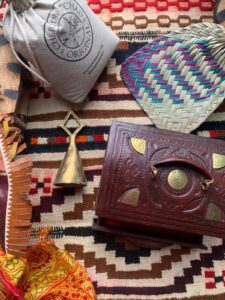
Our home is filled with pieces that carry meaning: an ancient kilim, the jewelry box that held the heirloom Chébé seeds for over a decade before we replanted them on the ancestral land, baskets woven by royal house artisans from Abéché, colorful handmade fans by the Mbororo women of Lake Chad, 19th-century camel bells, pottery from Gaoui. A Danish design chair sits beside a Chadian rug. The lamp above the dining table is Danish. Family photographs line the walls alongside watercolors painted by my daughter. Nothing is decorative for decoration’s sake – everything has a story or a function.
My office is my command center. The walls are covered in brand imagery, product photography, and press – including our American Vogue feature, when they traveled to Chad with me, visited our farm, and captured the Chébé ritual firsthand. There is an evolving moodboard that reflects whatever I am working on at the moment, vintage baskets, and shelves of books on art, history, and business. A gallery of photographs from our farm and our proprietary technology lines the lab corner, where formulations are tested and refined. A hundred-year-old traditional mortar sits in the room – it has crushed Chébé for generations. A few of the over forty awards Chéribé has won since launch are on display. The brand is not built somewhere else and managed from here. It is built here.
Years ago, my friend Lichelle Silvestry, an American interior designer in Paris, introduced me to the idea of “instant home wherever I go” – a few intentional objects, a few rituals, and you are anchored. I recognized it immediately: my people, the nomads of the Sahel and central Sahara, have practiced this since forever. It was not a new concept – it was an ancient one, reframed. I simply embraced what was already mine. I bring fresh flowers home from the farmers’ market every week. It keeps the space alive. And we do not save our finest linen or tableware for special occasions. Having a home and sharing a meal with the people you love is the occasion. We celebrate that every day.
My home is honest. It is not curated for anyone else. It is where I land and prepare for what comes next.
H+W
What is your favorite room in your home, and why?
Salwa
Our terrace, living room, kitchen, and dining room form one open, cross-through space, flooded with light from both sides – and that openness is my favorite “room.” It is where everything converges. I read, take calls, and work. My daughter plays. We pray, cook, host close friends and family, watch movies, draw, and do homework. It is where I braid my daughter’s hair, and where my mother or sisters braid mine when they visit. I have already begun teaching her the Chébé ritual with the Chéribé products – the same way my great-grandmother taught me. Not with instructions, but with presence. She watches my hands lovingly combing her tailbone-length hair. She asks questions. Chadian braids are gentle on the scalp – she falls asleep on my lap while I braid her hair. One day, she will do this for her own daughter, and the line will continue.
My mother composed a lullaby for me as a baby, in Dazaga, praising the beauty of her daughter. When she hums it while braiding my hair wherever we are, I am home.
We cook Chadian meals with spices blended by my maternal grandmother. We brew tea and coffee from our family farm. Drinking something grown on your own land, thousands of miles away, is its own kind of homecoming.
That space holds the most versions of us in a single day. It is where we are most ourselves – and we protect it. Not everyone is invited in. Home is where you are unguarded.
H+W
What does coming home mean to you, and what kind of legacy do you hope to leave, both personally and professionally?
Salwa
Coming home means returning to yourself (your values, your people, your truth) especially after the world has pulled you in every direction.
Professionally, I am building a hundred-year brand. I come from a culture that thinks in centuries. I want Chéribé to prove that you can build something global without erasing where it came from; that excellence and integrity can coexist.
Personally, I want my daughter to know her mother built something real – not just successful, but honest. And I want the women in Chad to know they were never invisible. They were always the beginning.
Chad is the cradle of humankind, home to over 8,000 years of rock art depicting beauty rituals and flourishing civilizations. We come from deep history. Chéribé is simply one more chapter in a very long story.
One item in your home you couldn’t part with?
My Chadian incense burner.
Music you love having on while you’re at home?
Silence – and the sound of my family. My mother humming my lullaby while braiding my hair. My siblings giggling. My husband and father debating a chess move. My daughter’s laughter.
Are you more of a host or a homebody?
Homebody.
City you feel most yourself in?
N’Djaména.
One word that describes how you want people to feel when they use Chéribé?
Named & Claimed.