
Nearly a year after appearing as a Hope+Wellth cover star, Arlinda Norris returns with a new title, author, and a book that had me inspired, surprised and occasionally wanting to reach through the pages and give her a little advice.
I thought I knew Arlinda Norris. After all, she was our Fall 2025 Hope+Wellth cover star. I had interviewed her, learned about her work and heard pieces of the story that shaped the woman she had become. When her debut book, She Kept Going, arrived, I expected to recognize much of the woman inside its pages. What I did not expect was how quickly I would realize that I had only known part of her story.
The first chapter stopped me in my tracks when Norris described a period during her childhood when she lived without running water or electricity. I sat with that revelation because it immediately changed the context for so much of what I already knew about her. The polished entrepreneur, designer and now author I had come to know had once been a little girl learning to adapt to circumstances many of us would have difficulty imagining. By the end of that chapter, I knew this was going to be a different reading experience than I had anticipated.
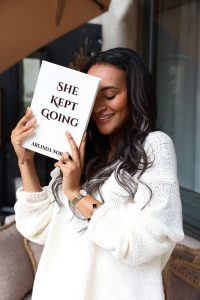
Norris released She Kept Going on August 16, her 50th birthday, and the experience begins  before you read a single word. My copy arrived inside a beautiful RLYNDA PRESS presentation box adorned with a compass resembling a North Star. Inside was a luxury cream linen edition with the title elegantly embossed across the cover. The presentation is sophisticated and thoughtfully executed, but once you start reading, you quickly forget about keeping that beautiful book pristine because it is difficult to put down.
Part of what keeps the pages turning is the way Norris tells her story. Even the chapter titles make you curious. Two of my favorites are “From Fashion Shows to Food Stamps” and “The Apple Watch.” I will not spoil either one because discovering what those titles mean is part of the fun, but they offer a glimpse into just how many unexpected turns her life has taken.
At times, She Kept Going feels less like reading a traditional memoir and more like watching a really good movie with a friend. You become invested enough to start talking to the main character. There were moments when I completely understood Norris’ choices and wanted to cheer her on, while there were others when I wanted to ask, “Arlinda, what are you doing?” You know she cannot hear you, but that does not stop you from offering advice anyway.
That may be one of the things I enjoyed most about the book. Norris does not rewrite her history to make every decision look brilliant because she now knows how everything turned out. Sometimes she is confident and certain, while other moments reveal a woman wrestling with complicated emotions and trying to make the best decision she can. Readers will understand some of her choices, question others and probably recognize themselves in more than a few.
That honesty keeps She Kept Going from becoming a perfectly packaged story about overcoming adversity. Instead, we get to watch how Norris problem-solves her way through it. When circumstances change, she assesses what she has, considers what she can control and figures out what she can do next. Sometimes she moves forward confidently, while other times she simply works with the information and resources available to her. There is something refreshingly practical about watching resilience unfold this way because real life rarely gives us the luxury of knowing how everything will turn out before we have to make a decision. Norris also shows that accepting the reality of a difficult season does not mean agreeing to stay there forever. Moving forward can mean rebuilding financially, reinventing a career, ending a marriage or betting on yourself before you know whether the bet will pay off.
As the book progresses, we watch Norris change. The woman we meet toward the end is not simply more accomplished than the woman we met at the beginning. She trusts herself differently. She has learned that confidence does not require knowing exactly what will happen next. It can mean believing that whatever happens, you will figure out what to do next. That transformation also gives her RLYNDA Philosophy greater meaning. Through her philosophy framework, we get to witness how she felt and why she did what did, almost in real time.
 There is also gratitude woven throughout She Kept Going, but Norris never suggests that every painful experience was wonderful simply because she eventually learned from it. Instead, she seems to understand that all the versions of herself belong to the same story and contributed to the woman writing it today.
By the time I finished reading, the compass on that RLYNDA PRESS box felt even more appropriate. A compass cannot eliminate difficult terrain or tell you what you will encounter along the way. It can simply help you find your bearings and determine which direction to take next. That is ultimately what She Kept Going offers. It is not the story of a woman who always knew exactly what to do. It is the story of a woman who repeatedly encountered a new reality and figured out how to move forward within it.
When Arlinda Norris appeared on our cover in 2025, I thought I understood the resilience behind the woman I was interviewing. After reading She Kept Going, I realize I only knew part of her story. This time, Norris gets to tell the rest herself, and she does it in a way that will have you rooting for her, questioning her choices, recognizing pieces of yourself and probably talking back to the book more than once.
Arlinda Norris kept going, and when you read this book, you’ll keep turning the pages. Buy your copy here and when you do, let me know what you think.